Difference between revisions of "AY Honors/Origami/Answer Key/es"
(Created page with "</noinclude>") |
(Updating to match new version of source page) |
||
| Line 49: | Line 49: | ||
<noinclude></noinclude> | <noinclude></noinclude> | ||
| − | + | <noinclude></noinclude> | |
| − | <noinclude | ||
| − | |||
{{CloseReq}} <!-- 2e --> | {{CloseReq}} <!-- 2e --> | ||
{{ansreq|page={{#titleparts:{{PAGENAME}}|2|1}}|num=2f}} <!--T:14--> | {{ansreq|page={{#titleparts:{{PAGENAME}}|2|1}}|num=2f}} <!--T:14--> | ||
| − | <noinclude> | + | <noinclude></noinclude> |
| − | </noinclude | ||
| − | |||
| − | + | <noinclude></noinclude> | |
| − | <noinclude | ||
| − | |||
{{CloseReq}} <!-- 2f --> | {{CloseReq}} <!-- 2f --> | ||
{{ansreq|page={{#titleparts:{{PAGENAME}}|2|1}}|num=2g}} <!--T:15--> | {{ansreq|page={{#titleparts:{{PAGENAME}}|2|1}}|num=2g}} <!--T:15--> | ||
| − | <noinclude> | + | <noinclude></noinclude> |
| − | </noinclude | ||
| − | |||
| − | |||
| − | |||
| − | |||
| − | |||
| − | + | <noinclude></noinclude> | |
| − | <noinclude | ||
| − | |||
{{CloseReq}} <!-- 2g --> | {{CloseReq}} <!-- 2g --> | ||
{{ansreq|page={{#titleparts:{{PAGENAME}}|2|1}}|num=2h}} <!--T:16--> | {{ansreq|page={{#titleparts:{{PAGENAME}}|2|1}}|num=2h}} <!--T:16--> | ||
| − | <noinclude> | + | <noinclude></noinclude> |
| − | </noinclude | ||
| − | |||
| − | |||
| − | |||
| − | |||
| − | + | <noinclude></noinclude> | |
| − | <noinclude | ||
| − | |||
{{CloseReq}} <!-- 2h --> | {{CloseReq}} <!-- 2h --> | ||
{{ansreq|page={{#titleparts:{{PAGENAME}}|2|1}}|num=2i}} <!--T:17--> | {{ansreq|page={{#titleparts:{{PAGENAME}}|2|1}}|num=2i}} <!--T:17--> | ||
Revision as of 13:14, 3 May 2021
Nivel de destreza
1
Año
1997
Version
11.06.2026
Autoridad de aprobación
Asociación General

1
2
Note: Almost every origami book has basic instructions and a set of folding symbols.
2a
2b
2c
2d
2e
2f
2g
2h
2i
2j
2k

k. Turn model over

Example use of symbol

Example use of symbol
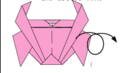
Example use of symbol


3
3a
- An outside reverse fold consists of two radial valley folds extending from a single point on a central fold and a reversal of the center fold on the affected end, all done simultaneously.
- An inside reverse fold consists of two radial mountain folds extending from a single point on a central fold, and a reversal of the central fold on the affected end, all done simultaneously.

Inside reverse fold

Outside reverse fold


3b
- A squash fold starts with a flap with at least two layers (for example, one flap of a waterbomb base). Make a radial fold from the closed point down the center of this flap. Open the flap and refold downward to make two adjacent flaps.

Squash fold applied to one flap of a waterbomb base

3c
- A petal fold starts with two connected flaps, each of which has at least two layers. (For example, two flaps of a preliminary base). The two flaps are attached to each other along a reference crease. Make two radial folds from the open point, so that the open edges lie along the reference crease. Unfold these two radial folds. Make another fold across the top connecting the ends of the creases to create a triangle of creases. Unfold this fold as well. Fold one layer of the open point upward and flatten it using the existing creases. A petal fold is equivalent to two side-by-side rabbit ears, which are connected along the reference crease.

Petal fold on one half of a preliminary fold

3d
See example at http://www.folds.net/tutorial/folds/book/book_diagrams.html
3e
- The preliminary fold consists of two perpendicular diagonal mountain folds that bisect the corners of the square and two perpendicular valley folds that bisect the edges of the square. The paper is then collapsed to form a square shape with four isosceles-right triangular flaps.

Preliminary fold
Petal fold on one half of a preliminary fold

3f
- A blintz fold is made by folding the corners of a square into the center. This can be achieved with higher accuracy by folding and unfolding two reference creases through the center.

4
In origami, there is a series of several bases that many models are created with. In general, "base" refers to any folded paper that immediately precedes final folding and shaping of the model-to-be.
4a
- The bird base, or crane base, consists of a preliminary fold with both the front and the back sides petal folded upward.
4b
- The waterbomb base consists of two perpendicular valley folds down the diagonals of the square and two perpendicular mountain folds down the center of the square. This crease pattern is then compressed to form the waterbomb base, which is an isosceles-right triangle with four isosceles-right triangular flaps. The waterbomb base is an inside-out preliminary fold.

4c
- The frog base starts with a waterbomb base or preliminary fold. All four flaps are squash-folded (the result is the same in either case), and then the corners are petal folded upward.
Other Bases
- The kite base is merely two valley folds that bring two adjacent edges of the square together to lie on the square's diagonal.
- The fish base consists of two radial folds against a diagonal reference crease on each of two opposite corners. The flaps that result on the other two corners are carefully folded downwards in the same direction. In other words, it consists of two side-by-side rabbit ears.
If a square is blintz folded, then a kite/fish/bird/frog base is folded, and the blintzed edges teased out and collapsed n a certain fashion, this is called a blintzed kite/fish/bird/frog/base, which doubles the complexity and adds more points and edges to the original kite/fish/bird/frog base, for a more complex model that requires more points. It's possible to double blintz for a double blintzed kite/fish/bird/frog base if needed. Theoretically an infinite number of blintzes could be performed to yield an infinitely complex multipointed base, but paper thickness restricts this to generally two blintzes.

Fish base

There is also the diamond base, the square base, the boat base, the pig base, the helmet base, the blintz base, and the organ base.😊
5
5a
5b
5c
5d
5e
6
Here's a paper rose from WikiHow:
6a
Here are a couple of links to WikiHow for making a jumping frog:
6b
6c
6d
6e
6f
6g
7
I find the boat the easiest.
8
 |
Tip for earning from home during the pandemic |
| After you fold the models, you can illustrate by sharing with your family. |
- Noah: ark (house on boat?) & bird
- Creation (you choose a variety of animals and make a male and female of each)
- Daniel's Lions
- Jesus' Parable of the lost sheep (you might NOT want to make 100 sheep, so think carefully through implementation). Rocks and bushes are foldable items and might privide a place to "hide" the sheep that the shepherd is finding.
- The four beasts of Daniel 7 (for advanced folders!)
- Zechariah 6:1-4 Horses and chariots. (for intermediant folders)
Other
Found these images, but they are not #5 or #6 above