AY Honor Patriarchs of the Bible Answer Key
Skill Level
1
Year
2017
Version
26.08.2026
Approval authority
North American Division

1
a. Patriarch (father of a tribe), the name given to the head of a family or tribe in Old Testament times. In common usage the title of patriarch is assigned especially to those whose lives are recorded in Scripture previous to the time of Moses, as Adam, Abraham, Isaac and Jacob. "In the early history of the Hebrews we find the ancestor or father of a family retaining authority over his children and his children’s children so long as he lived, whatever new connections they might form when the father died the branch families did not break off and form new communities, but usually united under another common head. The eldest son was generally invested with this dignity. His authority was paternal. He was honored as central point of connection and as the representative of the whole kindred. Thus, each great family had its patriarch or head, and each tribe its prince, selected from the several heads of the families which it embraced." --McClintock and Strong. "After the destruction of Jerusalem, patriarch was the title of the chief religious rulers of the Jews in Asia and in early Christian times it became the designation of the bishops of Rome, Constantinople, Alexandria, Antioch and Jerusalem." American Cyclopedia. Dr William Smith “Entry for Patriarch”. “Smith’s Bible Dictionary”. 1901.
2
NOTE: This could include – Adam (Gen 2:1-5:5), Noah (Gen 5:29-9:29), Abram or Abraham (Gen. 11:26-25:10), Isaac (Gen. 21:1-35:39, Jacob (Gen. 25:24-33:20 & 35:1-49:33).
2a
Your answer will vary based on the patriarch you chose. This may be done individually or as a unit activity.
2b
Your answer will vary based on the patriarch you chose. This may be done individually or as a unit activity.
2c
Your answer will vary based on the patriarch you chose. This may be done individually or as a unit activity.
2d
Your answer will vary based on the patriarch you chose. This may be done individually or as a unit activity.
3
Jacob. His two wives, Leah and Rachael, and their maids Zilpah and Bilhah are the mothers of the twelve sons who became the fathers of the twelve tribes of Israel. Note that Joseph received a "double portion" in that instead of a tribe of Joseph, there are two tribes of his lineage "Ephraim and Manasseh."
The 12 include (in birth order):
- Reuben son of Leah (Gen. 29:32)
- Simeon son of Leah (Gen. 29:33)
- Levi son of Leah (Gen. 29:34)
- Judah son of Leah (Gen. 29:35)
- Dan son of Bilhah (Gen. 30:4-6)
- Naphtali son of Bilhah (Gen. 30:7-8)
- Gad son of Zilpah (Gen. 30:10-11)
- Asher son of Zilpah (Gen. 30:12-13)
- Issachar son of Leah (Gen. 30:17-18)
- Zebulun son of Leah (Gen. 30:19-20)
- Joseph son of Rachel (Gen. 30:23-24)
- Benjamin son of Rachel (Gen. 35:16-18)
-
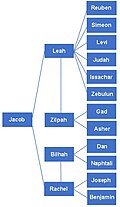 Family Tree of Jacob and his 12 sons who became the 12 tribes of Israel
.jpg)
4
Moses – seen as the Father of Israel as an independent nation because he led them out of Egypt David – seen as the father of Israel because he was considered the greatest king
Some might say that Job is the third patriarch, but there is wide disagreement among Biblical scholars on this point so the two main patriarchs are mentioned here and fulfill the requirement.
5
Patriarchs and Prophets is available in a variety of formats:
OUR RECOMMENDATION - Beginning of the End (PP Adaptation)
OUR RECOMMENDED AUDIO - Beginning of the End (PP Adaptation) Audio
These adaptations are White Estate approved, and are published by Pacific Press. They are used in the Adventist Encounter Curriculum.
- Adam – Chapter 2 (Creation) PP chapter 2 Creation Beginning of the End chapter 2 Creation: God's Answer to Evolution
- Noah – Chapter 7 (The Flood) PP chapter 7 The Flood BOE - When the World was Destroyed By Water
- Abram or Abraham – Chapter 11 (The Call of Abraham) PP chp 11 The Call of Abraham BOE - Abraham, the Father of All Believers – There are several other chapters that would also work
- Isaac – Chapter 15 (The Marriage of Isaac) PP chp 15 The Marriage of Isaac BOE - Isaac's Marriage the Happiest in the Bible – There are several other chapters that would also work
- Jacob – Chapter 16 (Jacob and Esau) PP - chp 16 Jacob & Esau BOE - Jacob & Esau – There are several other chapters that would also work
- Moses – Chapter 22 (Moses)PP - chp 22 Moses BOE - Moses: The Leader of God's People – There are several other chapters that would also work
- David – Chapter 62 (The Anointing of David) PP - chp 62 The Anointing of David BOE - David Anointed as King– There are several other chapters that would also work
6
Look specifically in verses 9, 13-14, and 18
7


7a
7b
7c
8
Genesis 12 and Genesis 22 together show the growth and deepening of Abraham’s faith over time. In Genesis 12, Abraham demonstrates initial faith by obeying God’s call to leave his homeland without knowing where he is going, trusting God’s promise of land, descendants, and blessing, yet his faith is still developing and sometimes mixed with fear and uncertainty. By Genesis 22, Abraham’s faith has matured into complete trust and obedience, as he is willing to sacrifice Isaac—the very child through whom God’s promises were to be fulfilled—believing that God would remain faithful even in an impossible situation. While both chapters emphasize obedience, Genesis 12 highlights faith that begins with promise and hope, whereas Genesis 22 reveals faith refined through testing, showing Abraham’s growth from trusting God for guidance to trusting God fully with what mattered most.
9
Reason God Changed Abram’s Name
- God changed Abram’s name to Abraham because of His covenant promise.
- God says: “Your name shall be Abraham, for I have made you the father of a multitude of nations” (Genesis 17:5).
- Abram means “exalted father”.
- Abraham means “father of a multitude.”
- The name change marked a shift from a personal title to a covenant identity tied to God’s promise, not Abram’s current situation (he had only one son at the time).
Time Frame
- Abram was 99 years old when God changed his name (Genesis 17:1).
- This occurred:
- 13 years after the birth of Ishmael (Genesis 17:25)
- About 24 years after God first called Abram at age 75 (Genesis 12:4)
Effect of the Name Change
- Confirmed and expanded God’s covenant with Abraham.
- Promised that:
- He would become the father of many nations (Genesis 17:4–5)
- Kings would come from him (Genesis 17:6)
- The covenant would be everlasting, including land and descendants (Genesis 17:7–8)
- Introduced circumcision as the sign of the covenant (Genesis 17:10–11).
- The name change publicly marked Abraham’s new God-given role and destiny, based on God’s promise rather than human ability.
10
1. Betrayed and Sold by His Brothers (Genesis 37) Bad situation:
- Joseph’s brothers hated him, threw him into a pit, and sold him into slavery.
- He was taken to Egypt, far from his family.
How God used it:
- This brought Joseph to Egypt, the exact place where God would later use him to save many lives.
- What looked like betrayal was actually God positioning Joseph.
2. Slavery in Potiphar’s House (Genesis 39:1–6) Bad situation:
- Joseph was a slave with no freedom or family.
How God used it:
- God gave Joseph favor and success.
- Joseph learned leadership, management, and integrity, preparing him for greater responsibility.
3. False Accusation and Prison (Genesis 39:7–23) Bad situation:
- Joseph was falsely accused by Potiphar’s wife and imprisoned for doing the right thing.
How God used it:
- Even in prison, God gave Joseph favor.
- The prison became a training ground, not a punishment.
- Joseph met people who would later connect him to Pharaoh.
4. Forgotten After Interpreting Dreams (Genesis 40) Bad situation:
- Joseph correctly interpreted dreams for Pharaoh’s cupbearer.
- The cupbearer forgot Joseph for two more years.
How God used it:
- God’s timing, not Joseph’s, was at work.
- Joseph was released at the exact moment Pharaoh needed him.
5. Interpreting Pharaoh’s Dreams (Genesis 41) Bad situation turned breakthrough:
- Pharaoh had disturbing dreams no one could explain.
How God used it:
- Joseph interpreted the dreams and gave wise advice.
- He was made second-in-command over Egypt.
- God used Joseph to prepare Egypt for a severe famine.
6. Famine and Reunion with His Brothers (Genesis 42–45) Bad situation:
- A widespread famine threatened many lives, including Joseph’s family.
How God used it:
- Joseph’s position allowed him to save Egypt and his own family.
- God preserved the family line that would lead to Israel and eventually the Messiah.
7. Joseph’s Final Understanding (Genesis 50:20) Key truth:
- “You meant evil against me, but God meant it for good, to bring it about that many people should be kept alive.”
Effect:
- Joseph recognized that every painful moment served God’s greater plan.
- God’s will was fulfilled through suffering, patience, and faithfulness.
11
What Joseph Was Trying to Ascertain Joseph wanted to determine whether:
- 1. They had changed in character (repentance instead of cruelty)
- 2. They would tell the truth rather than deceive
- 3. They would protect Benjamin or abandon him as they abandoned Joseph
- 4. They would accept responsibility for past sin
- 5. They would act selflessly, even at personal cost
Joseph’s Tests and Their Purpose 1. Accusing Them of Being Spies (Genesis 42:9–17) Test:
- Joseph accused his brothers of spying and imprisoned them briefly.
Designed to show:
- Whether they would remain truthful under pressure
- Whether they could defend themselves honestly
- Forced them to reveal information about their family, including Benjamin
2. Keeping Simeon as a Prisoner (Genesis 42:18–24) Test:
- Joseph detained Simeon and sent the others home.
Designed to show:
- Whether the brothers would return for Simeon
- Whether they would abandon another brother when it became inconvenient
3. Returning Their Money in Their Sacks (Genesis 42:25–28; 43:12) Test:
- Joseph secretly returned their payment for the grain.
Designed to show:
- Whether they would act honestly or keep money they did not earn
- Whether guilt would surface (it did—showing a troubled conscience)
4. Requiring Benjamin to Come to Egypt (Genesis 42:20; 43:29) Test:
- Joseph insisted they bring their youngest brother.
Designed to show:
- Whether they would risk themselves to protect the favored son
- Whether jealousy toward Rachel’s other son (Benjamin) still existed
5. The Feast and Seating Arrangement (Genesis 43:33–34) Test:
- Joseph seated them in birth order and gave Benjamin five times more food.
Designed to show:
- Whether favoritism would rekindle jealousy
- Whether they could rejoice instead of resent Benjamin’s blessing
6. The Silver Cup in Benjamin’s Sack (Genesis 44) Test:
- Joseph framed Benjamin for theft and threatened to enslave him.
Designed to show:
- Whether the brothers would sacrifice Benjamin to save themselves
- Whether they would stand together as a family
- Judah’s offer to take Benjamin’s place showed true repentance and transformation
The Result
- Judah’s self-sacrifice (Genesis 44:33–34) proved the brothers had changed.
- Joseph now knew:
- They would not repeat the sin they committed against him
- They had grown in responsibility and love
- This cleared the way for reconciliation and forgiveness (Genesis 45).
12
Stage 1: Prince in Egypt (about 40 years) Moses spent his first forty years in Egypt as the adopted son of Pharaoh’s daughter. During this time, he learned leadership, education, and confidence through Egyptian training, while also becoming aware of his Hebrew identity. This stage ended when Moses killed an Egyptian who was abusing a Hebrew slave, forcing him to flee Egypt after Pharaoh sought his life (Exodus 2:11–15).
Stage 2: Shepherd in Midian (about 40 years) Moses lived the next forty years in Midian as a shepherd, a dramatic change from palace life. Here he learned humility, patience, and dependence on God, as well as how to guide and care for others—skills needed for leading Israel. This stage ended when God appeared to Moses in the burning bush and called him to return to Egypt to deliver His people (Exodus 3:1–10).
Stage 3: Leader of Israel (about 40 years) The final forty years of Moses’ life were spent leading Israel out of Egypt and through the wilderness. During this time, Moses learned obedience, intercession, and reliance on God’s power as he confronted Pharaoh, received the Law, and guided a difficult nation. This stage began with the Exodus and continued until Moses’ death at age 120, after God appointed Joshua as his successor (Deuteronomy 34:5–7).
12a
12b
12c
13
God kept Moses from entering the Promised Land because Moses disobeyed God and failed to honor Him as holy when he struck the rock instead of speaking to it as God commanded (Numbers 20:7–12).
14
Although Moses died and his burial place was never revealed (Deuteronomy 34:5–6), Scripture gives strong evidence that he is in Heaven.
- Jude 1:9 records that the archangel Michael disputed with the devil over Moses’ body, implying that Moses belonged to God and that his death did not place him under Satan’s authority.
- More clearly, Moses appeared alive and glorified with Elijah at the Transfiguration of Jesus (Matthew 17:1–3; Mark 9:4; Luke 9:30), speaking with Jesus about His coming death, which shows Moses was conscious, honored by God, and present in God’s glory. Since Elijah never died and Moses appeared alongside him in this heavenly scene, the Bible strongly supports the conclusion that Moses is alive with God in Heaven despite having been barred from entering the Promised Land on earth.
15
Summary of Joshua-Video for kids[1]
Joshua and Caleb trusted God after the spy report
- When the other spies feared the people of Canaan, Joshua stood firm and urged Israel to trust God’s promise.
- “Do not rebel against the LORD… The LORD is with us. Do not fear them.” (Numbers 14:8–9)
Joshua obeyed God at the Jordan River
- While the people faced an impossible crossing, Joshua followed God’s command to step into the river before it parted, demonstrating faith in God’s power.
- “As soon as the priests… set foot in the Jordan, its waters flowing downstream will be cut off.” (Joshua 3:13)
Joshua trusted God’s plan at Jericho
- Instead of using military strategy, Joshua obeyed God’s unusual command to march around the city, trusting God to give victory.
- “See, I have delivered Jericho into your hands.” (Joshua 6:2)
Joshua publicly challenged Israel to remain faithful to God
- When the people were tempted to serve other gods, Joshua declared his own unwavering commitment to the LORD, calling the nation to choose faithfulness.
- “Choose for yourselves this day whom you will serve… but as for me and my house, we will serve the LORD.” (Joshua 24:15)
16